How to Check a Cropped Photograph Before Trusting Its Caption
Check a cropped photograph against its source, caption and visible context so you can distinguish what the image shows from what its framing suggests.
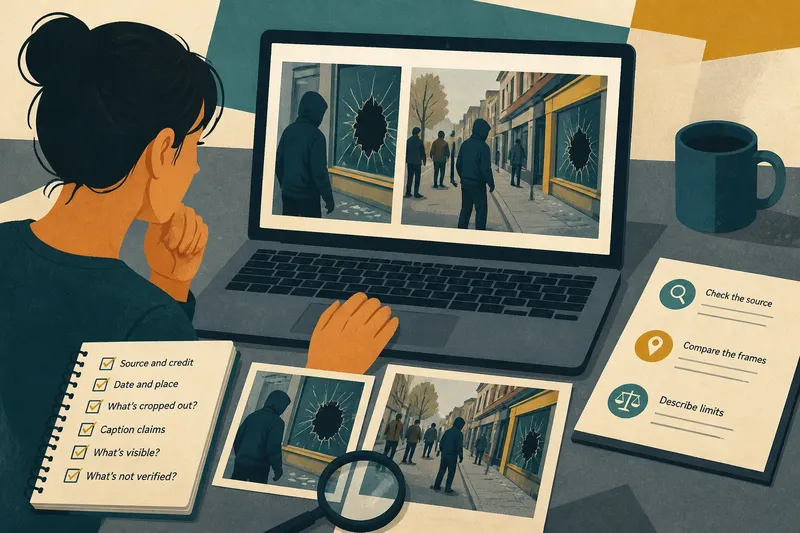
A cropped photograph of someone beside a damaged shopfront can make the person seem responsible for the damage. To check a cropped photograph, compare its source, caption and framing before deciding what the image supports.
A crop changes what the scene appears to show
Cropping changes the visible relationships between people and objects. A narrow frame might leave out a crowd, a sign, another person or the edge of an object, making what remains seem isolated or unusually prominent.
The selection can suggest a story without changing the details that remain visible. A close view of someone holding a placard may imply that its message represents a whole gathering; a wider image might include other signs or a nearby street. Even then, the wider view does not necessarily explain the event.
Not every crop is deceptive. Editors may use one to fit a page or focus attention on a detail. The useful question is whether the framing encourages a consequential claim that the wider scene or other reporting does not support.
Find a credible source and compare the frames
Start with the place where you encountered the photograph. Note the account or publication, the caption, any date or location, and whether the post links to a report or credits a photographer. A screenshot may have lost details that would help trace the image.
You can use a reverse image-search service, such as Google Lens or Bing Visual Search, to look for matching or similar images. Treat results as leads, not confirmation: they may surface reposts of the same crop, and a wider version may not appear.
Search distinctive wording from the caption alongside the claimed place or event. Compare visible details such as shop signs, clothing or street furniture across versions. A larger frame is not automatically the original; it could be a different photograph of the scene or a later edit.
Use this checklist to decide what to do next:
- Check the post’s photographer credit or publication link. If it leads to a source page, compare its image and caption; if it does not, search the caption wording and keep the attribution uncertain until a source appears.
- Check whether the caption names a date and place. If those details are supported by a source page, compare them with other versions; if they are absent or inconsistent, do not repeat them as established facts.
- Check the edges of each image for missing people, signs, vehicles or objects. If a difference could alter the claim, investigate that detail; if only the border changes, it may not be worth further effort.
- Check whether the wider image has its own clear credit and caption. If it does, compare that information with the cropped version; if it does not, treat it as an unverified alternative rather than the original.
- Check what the image visibly establishes about a person’s actions. If the action is shown clearly, describe only that visible action; if it is inferred from proximity or context, seek corroboration before assigning responsibility.
- Check whether the source describes the image as a file photograph, illustration or scene from a particular event. If the description conflicts with the post, report the discrepancy; if the source cannot be located, state that the image’s status remains uncertain.
Keep the photograph separate from its caption
A caption makes claims that the image may not prove. “A shop damaged during Saturday’s demonstration” links the scene to a time and event; “protesters smash a shop window” also describes an action and assigns responsibility. Check each part rather than treating the caption as a label established by the photograph.
Compare the wording with the source’s full report and, where available, other credible accounts. Notice whether the words describe what is visible, attribute a claim to a source or present an account the publication says it has established.
Say you encounter a post showing a person beside a broken window, with a caption accusing them of smashing it. The starting evidence is the crop and that accusation. You check the linked report, search the caption wording, then find a wider image with a credit that shows the person facing away from the window; the comparison weakens the post’s visual case but does not identify who broke the glass. The defensible result is that the crop does not demonstrate the accusation, while responsibility remains unresolved.
Describe the limits of what the frame can establish
A photograph may show that a person stood near a damaged window. By itself, it may not establish who caused the damage, when it happened or why that person was there. Those claims need support from reporting or other records, not a more confident reading of the frame.
Intent behind a crop can also be difficult to determine. It may have been selected for layout, supplied by an agency or chosen to steer interpretation. Describe the observable effect first: what is excluded, what impression the crop encourages and whether a source explains the choice.
It is not worth tracing every minor difference between copies when it has no bearing on the claim. Focus on missing context that could change who, what, where or when, rather than a border difference that leaves the interpretation unchanged.
Which questions help you check a cropped photograph?
Can reverse image search establish which version came first?
No. It can help locate matching or similar copies and a possible source, but results may lead back to an already cropped image. Check the attribution and caption at the source before deciding which version is more credible.
Does a wider frame settle what happened?
Not necessarily. It can restore visual context or challenge a caption, but still shows only a limited view at a particular moment.
What if no wider version turns up?
Keep your claim within what the available image and a credible caption support. If the missing context matters, say that the crop leaves it unresolved rather than presenting an inference as fact.
How should you share an image with uncertain context?
Include its source and the exact caption, and identify what remains unverified. If the image could wrongly implicate someone, pause before sharing rather than adding a guess.
Write a narrower account when the evidence is narrow
Separate visible detail from interpretation. “The image shows a person beside a damaged shopfront” says less than “the person damaged the shop”; “the post identifies this as a protest” makes clear where the event label came from.
When checking a cropped photograph, preserve its source and caption, compare the available framing and make uncertainty clear. A careful account does not need to solve the whole event. It needs to distinguish what the picture shows from what a reader might infer.