A Named Expert, an Anonymous Source, and What Each Can Establish
Learn how to assess named experts and anonymous sources by checking their access, interests and supporting evidence before deciding how much a claim establishes.
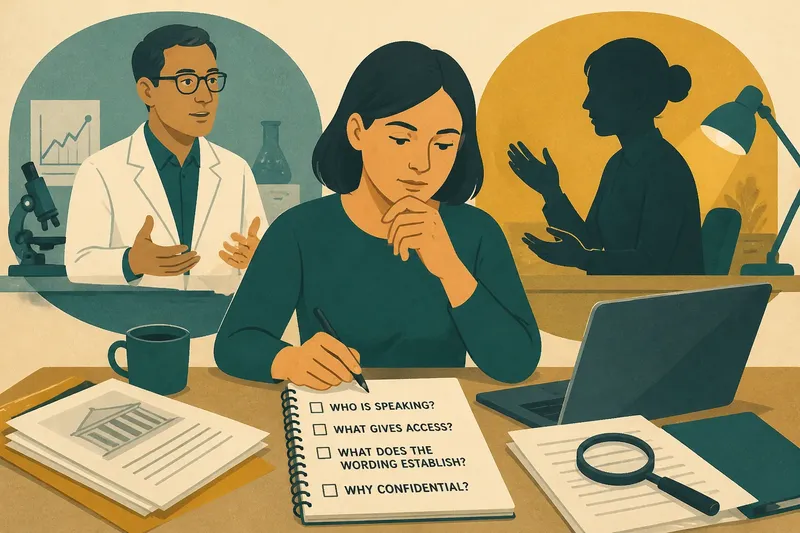
A report says a named scientist interprets a new finding, while an unnamed employee describes a decision made behind closed doors. To assess named experts and anonymous sources, separate what each person can know from what the article has independently established.
A name helps assess expertise, not every claim
A name gives readers a place to begin. It can make a speaker’s professional role, relevant work and possible interests easier to check, but a credential is not a universal licence to speak authoritatively on every part of a story.
A climate scientist may be well placed to explain how a measurement is collected, but not necessarily to interpret a local planning dispute or assess a company’s private motives. A former minister may understand how a department works yet lack direct knowledge of a decision made after leaving office. Expertise has boundaries, and careful reporting makes them visible.
Look for the connection between the person’s work and the specific claim. “Professor of biology” supplies context; it does not establish that the person examined a particular specimen or reviewed the underlying data. The useful question is what the expert actually assessed.
Interests matter too. A consultant may advise an organisation involved in the story, or an advocate may have a public position on the policy under discussion. These interests do not automatically invalidate an account, but they can help explain why a person is speaking and which perspectives may be missing.
Access determines what a source can know directly
Expertise and access are different. Someone can understand a field deeply but have no direct view of a particular event; someone else may have witnessed a conversation without the specialist knowledge to interpret its technical meaning.
Reporting often combines these forms of knowledge. A named engineer might explain what a component does, while a worker who was present describes how it was handled. Their accounts answer different questions, so one should not be treated as a substitute for the other.
When a source describes an event, notice whether the article says they saw it, heard it, took part or learnt about it afterwards. “An official said the proposal was discussed” leaves open whether that official attended. “An official present at the meeting said…” makes the claimed access clearer, though the account still needs assessment.
For claims about records, ask whether the source read the document, helped prepare it or is summarising what someone else said. A person may accurately report what they were told without being able to confirm the underlying record.
Anonymity should come with a reason and useful context
In careful reporting, the newsroom knows who an anonymous source is, while readers receive a description that withholds identifying details. Confidentiality may protect someone facing retaliation, loss of workplace access or another credible risk for speaking publicly.
A useful account explains, as far as safety allows, why the source is unnamed and what position gives them access. “A staff member involved in preparing the proposal, speaking on condition of anonymity because they were not authorised to discuss it” offers more context than “a source said”.
The explanation should not reveal details that identify the person indirectly. In a small team, a precise job title or narrowly defined role could make anonymity meaningless. The newsroom needs to give readers enough context to assess relevance without defeating the protection.
A source may also have reasons for speaking beyond a wish to expose a problem: they might be trying to shape an internal dispute or protect their own position. Those possibilities do not prove bad faith. They are reasons to distinguish the account from what the reporting independently establishes.
Confidentiality does not verify an account
Withholding a name can explain why readers cannot check a source’s identity; it cannot, by itself, confirm that the account is accurate. A reporter may know the source and still need records, other witnesses or a response from people criticised. The article should show what is supported beyond the confidential account.
Pay attention to the wording. “The official said the department had rejected the plan” attributes an assertion. “The department rejected the plan” presents the event as established. A story may have grounds to use the second form, but readers should be able to see whether those grounds include documents, on-record confirmation or corroborating accounts.
Corroboration adds most value when it supplies independent support, not merely another voice repeating the same information. Two people who heard a rumour from the same colleague may not provide separate routes to the fact. A document can help, though its origin, completeness and meaning may also need checking.
Nor does a named source automatically confirm another named source. Two spokespeople may repeat an agreed account from the same organisation: the names are visible, but the information may still have a shared origin.
Read attribution as a compact account of evidence
Attribution phrases often carry more information than they first appear to. “According to a filing” points towards a document; “according to a lawyer familiar with the case” points towards a person whose knowledge may be direct or second-hand. “The report says” identifies a source for a statement, but not necessarily who produced the report or how its authors reached that conclusion.
Use the following checks to decide what an article’s attribution supports. For each one, compare what the story says with the evidence it identifies, then keep your conclusion within that scope.
- Who is speaking? If the person is named, check whether the article also gives a relevant role; if the description is vague, treat the source’s authority as harder to assess and avoid relying on it alone.
- What gives them access? If the story identifies direct involvement, assess the account as first-hand evidence; if it describes only second-hand knowledge, treat it as a report of what someone else said.
- What does the wording establish? If the sentence says someone made a claim, attribute it to them; if it presents an event as fact, look for the documents, confirmation or independent accounts supporting that stronger wording.
- Why is the source confidential? If the article gives a concrete reason without exposing the person, use that context to assess the arrangement; if no reason is given, leave the source’s motive and the rationale for anonymity unresolved.
- What supports the account independently? If the story supplies a document or a separate witness with an independent route to the information, consider that additional support; if it offers only repetitions of one account, do not count them as separate confirmation.
- What is the claim’s scope? If the evidence concerns one meeting, document or workplace, keep your conclusion to that setting; if the article generalises beyond it without showing broader support, treat the larger claim as unestablished.
These checks are not a verdict machine. They help locate where confidence is warranted and where uncertainty remains. If an article leaves an important gap, you can reserve judgement without dismissing the whole report.
How should you read claims from experts and confidential sources?
Does an expert’s title prove a claim is correct?
No. A title can indicate relevant training or experience, but the claim still needs to fit the person’s field and the evidence they examined. Check whether the article explains the expert’s basis for speaking, rather than relying on the credential alone.
Can an anonymous source establish that an event happened?
An anonymous source can provide evidence, especially with direct access, but anonymity does not make the account independently confirmed. Look for clear attribution and supporting material or separate corroboration, and note whether the story distinguishes an allegation from an established fact.
Why might a source ask not to be named?
A source may face a credible risk to their job, safety or ability to speak freely if identified. The article should explain that risk where it can do so safely; a vague appeal to confidentiality gives readers less context.
What if an article gives no reason for anonymity?
The omission limits what readers can assess about the arrangement. Treat the statement as an attributed claim, rather than as a fact made certain by the newsroom’s decision to withhold a name.
Keep the claim narrower than the source’s reputation
Say you read a report in which a named epidemiologist explains why a disease-surveillance method can miss some infections, while an unnamed hospital employee says a particular ward changed how it recorded cases. The expert may help interpret the method; the employee may have direct access to one ward’s practice. Neither account alone establishes that the same change occurred across every hospital.
In this invented situation, the starting information is an expert’s explanation of the method and one employee’s account of a single ward. The reader then checks whether the report cites records, another hospital or an official response. If it does, those sources may support a broader conclusion; if it does not, the defensible answer remains limited to what the expert can explain and what the employee says happened in that ward. The trade-off is clear: a narrower claim carries less reach, but avoids treating one account as evidence about every hospital.
It is not worth trying to identify an anonymous source from clues in the article. Guesswork can expose the wrong person and rarely improves understanding of whether the evidence supports the claim. Focus instead on stated access, the reason for confidentiality and what else the report establishes.
When a story turns on named experts and anonymous sources, read the attribution as part of the evidence, not as decoration. A name can clarify expertise and interests; confidentiality can protect access to information; neither settles the claim without attention to what the person knows and what supports the account. The phrase named experts and anonymous sources is most useful as a prompt to compare each statement’s basis with the conclusion the article asks you to accept.