The Long Road from Handwritten Dispatch to Newsroom Copy
Handwritten dispatch to newsroom copy reveals how paper, telegraph and newsroom routines shaped the surviving record—and what readers can learn from its gaps.
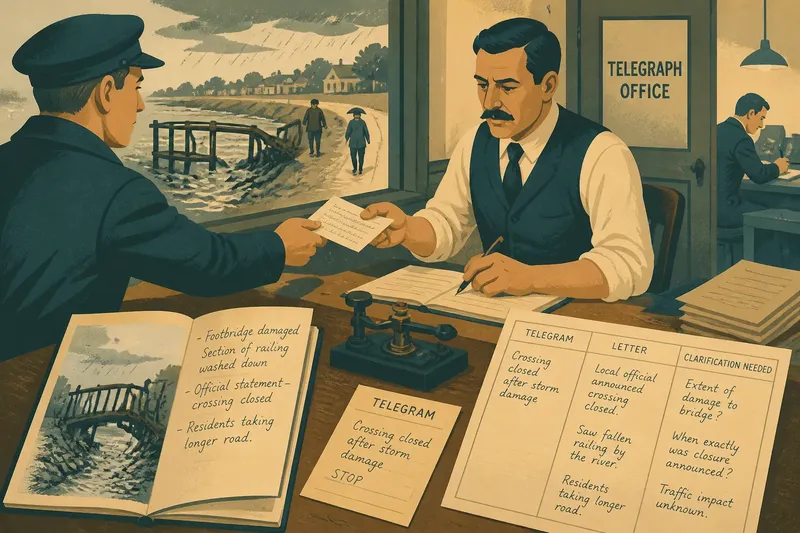
At a railway station, a correspondent passes a folded sheet of hurried handwriting to a clerk near the telegraph office. The journey from handwritten dispatch to newsroom copy is not only a story of speed: each carrier and office routine determines what survives, what is shortened and what can later be compared.
Paper preserves a fuller account but delays its arrival
Imagine a correspondent in a fictional riverside town where a storm has damaged a footbridge. In a notebook, they record a fallen section of railing, a local official’s statement that the crossing is closed, and residents taking a longer road. The notes remain a working record: they can include detail and sequence that would be awkward to send in a brief message.
A letter can carry that fuller dispatch to a newspaper office, along with corrections or descriptions added after the first observation. But the newsroom cannot use material that has not arrived. An editor working from an earlier message may face a different set of choices from one who later receives the complete handwritten account.
The telegraph creates an early, separate version
A telegram offers a way to send a short report ahead of the post. Its brevity is not merely a matter of fewer words; the sender must choose which details to transmit now and which to leave for the longer dispatch. That choice can make the telegram a distinct version of the report rather than a miniature copy of it.
In the invented bridge account, the correspondent might telegraph that an official has closed the crossing after storm damage, then send fuller notes by post. If the short message leaves out the official’s role, a desk could mistake a reported decision for something the correspondent personally established. The later letter may restore the missing context, but it does not erase the fact that the newsroom first received a narrower account.
Transmission leaves a paper trail with gaps
A telegraph message passes through operators and is written down at the receiving office. Handwriting, transmission and transcription each create opportunities for a word to be misread or omitted. A newsroom can preserve the received text, note when it arrived and keep it alongside the later letter; these records make comparison possible without pretending to recover every lost detail.
Imagine the telegram says “crossing closed” while the letter specifies that a local official announced the closure. The editor can compare the two documents, ask the correspondent for clarification if a return message is practical, or retain the narrower wording until the source is clear. The observable result is a copy draft that does not silently turn an incomplete phrase into a broader assertion.
Editors reconcile versions rather than simply polish prose
When the fuller dispatch arrives, an editor can place its details beside the telegram and mark what was added, qualified or corrected. In the fictional report, the correspondent saw the railing beside the river but did not inspect the whole bridge; the closure came from an official. A careful account keeps those distinctions attached to the relevant details.
The editor also decides what readers need first. The closure may lead because it affects people trying to cross, while the visible damage and the source of the closure follow. This ordering shapes emphasis, but it should not turn a partial observation into a claim about the bridge’s entire condition.
For a small newsroom handling paper records, a useful comparison can be made with a simple three-column sheet: wording in the telegram, wording in the letter, and the point that still needs clarification. If the versions agree, the editor can carry the shared detail forward; if they differ, the copy can preserve the difference or wait for a reply. The sheet is useful because it makes the editorial decision visible, not because it settles which account is correct.
Why does the route from dispatch to copy matter?
What did a dispatch contain?
A dispatch was a correspondent’s report sent from the place where an event was unfolding. It could combine notes, descriptions and information gathered from others, with the finished copy shaped later at the newspaper office.
Why send both a telegram and a letter?
A telegram could alert the newsroom sooner, while a letter could carry more of the correspondent’s account. Reading both versions together helps explain how the first report differed from the fuller record.
What can a newsroom record reveal?
Arrival notes, incoming messages and later correspondence can show which account the editor had at a particular stage. They may also reveal where the surviving record is incomplete, rather than resolving every uncertainty.
What is not worth reconstructing?
Without evidence, trying to imagine each possible slip by an operator or clerk adds speculation rather than useful context. It is more productive to compare documents that survive and identify what the newsroom could actually see.
The published account reflects the documents available at the desk
In the invented bridge report, the telegram supplies an early alert, the letter adds the correspondent’s observations and the editor’s comparison keeps the two versions from merging unnoticed. The resulting story can show how the account developed without suggesting that its first transmission contained everything the later record made clear.
For readers tracing handwritten dispatch to newsroom copy, surviving drafts and incoming messages are often more revealing than a guess about what happened on the wire. They show the newsroom’s changing materials and the decisions made with them. A missing letter or an absent correction remains a limit of the archive, not an invitation to fill the gap with certainty.