Reading a Developing Story Without Filling the Gaps
Reading a developing story without filling the gaps helps you track what changed, what remains unresolved and when another update is worth your attention.
A train alert says a line has closed, and a second notification arrives before you have finished reading the first. Reading a developing story without filling the gaps is easier if you keep a small record of what changed, rather than trying to hold every alert in your head.
Keep a change log, not a running theory
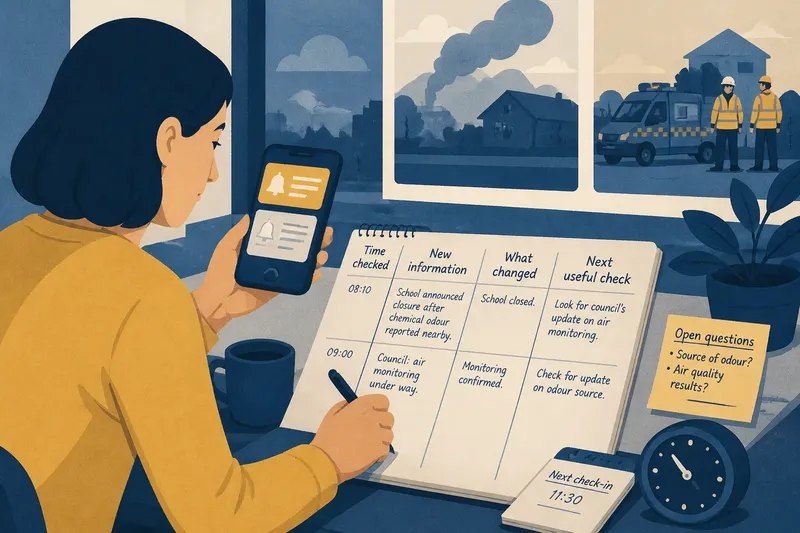
Open a note on your phone or use a sheet of paper. Give it four headings: time checked, new information, what changed and next useful check. The point is to track the story’s movement, not to assemble a complete explanation from fragments.
Write each update in plain language and keep the source attached to it. “The rail operator says the line is closed” records an announcement. “The line is closed because of a collision” adds a cause, so use that wording only if the report supports it.
For each new item, make one of three decisions:
- Record it if the report adds a specific development; note what changed and who reported it.
- Leave it pending if it is a prediction, an attributed claim or a question the report has not answered; preserve the wording and source.
- Set it aside if it repeats information already in your note without adding a new basis or detail; keep the existing entry rather than treating repetition as progress.
- Revise an earlier entry if a correction or new account changes it; retain a brief note of the earlier wording and what replaced it.
- Check the responsible service if you need current operational information for an immediate decision; use its direct update rather than relying on a chain of reposts.
- Choose a later check-in if nothing in the update affects a decision you need to make now; stop refreshing until that planned moment.
Imagine a fictional local report at 8.10 am says a school has closed after a chemical odour was reported nearby. You note: “School announced closure”; under the next check, you write “look for the council’s update on air monitoring”. At 9.00 am, a fictional council statement says monitoring is under way, so you add that as an attributed update and leave the odour’s source unresolved. If a later report says pupils are being collected, you record that separate development; it does not answer the open question about the source.
Let the clock shape your attention
Choose a time to revisit a story based on what you need from it: before travelling, during a planned break or when an organisation has said it will issue an update. If the story affects an immediate choice, check the relevant service or authority directly. Otherwise, a stream of alerts can consume attention without making the picture clearer.
On returning, compare the latest report with your change log. Ask whether it introduces a new event, corrects an earlier detail, adds a new source or merely repeats the same statement. A later timestamp by itself is not a reason to rewrite your understanding.
It is not worth saving every alert, refreshing several live pages in parallel or building a minute-by-minute timeline when none of those actions could change what you need to do. A short note and a deliberate check-in are usually enough to show whether the story has moved.
Separate the event from its explanation
A developing story may contain distinct strands: what happened, who was affected, what response followed and what may have caused the event. Track these separately. A confirmed response does not settle the cause, and a witness’s account may describe only the part visible from their position.
When accounts differ, write down the disagreement without inventing a way to reconcile it. Note who gave each account and whether the report explains why they differ. If it does not, “accounts differ” is a more useful record than a confident guess.
Context also needs a clear connection to the current event. A previous disruption or policy dispute may help explain a decision, but it does not establish why something happened now. Include background when it answers a specific question; leave out comparisons that only make an incomplete account feel finished.
How should you handle a changing report?
What should you do when an update corrects an earlier detail?
Amend the note and retain a short record of what the earlier report said. That lets you distinguish a correction from a new development without continuing to rely on the superseded detail.
Should you treat a repeated claim as new information?
Check whether the newer report adds a separate source or new reporting, rather than repeating the same statement. If it adds neither, keep the original entry and mark the later version as repetition only if that matters to your record.
What if the headline says more than the report supports?
Use the more qualified wording in your note and read the relevant passage in the article. If the difference remains unclear, look for a correction or a later publisher update before repeating the stronger claim.
When is it sensible to stop checking?
Pause when another update is unlikely to alter a decision you need to make, or when the latest coverage adds no new information. Set a later check-in if the story still matters rather than responding to every alert.
Make the next check answer a real question
Before opening another update, write down what you are looking for: whether a service has resumed, whether an official statement has changed, or whether an earlier detail was corrected. If no likely answer would affect your understanding or next action, the check can wait.
Reading a developing story without filling the gaps means letting the record remain unfinished where the reporting is unfinished. A useful final note is not a complete account of what happened; it is a clear marker of what changed, what still needs an answer and when that answer would be worth checking.